


Milan 2026: Fashion Facing the Mirror


Between robots, new creative directions, reinvented garments, and an industry that needs to start selling again, Milan Fashion Week left us with a question bigger than what will be in fashion: What does it mean to remain human in fashion?
For one week, Milan once again became one of the undisputed capitals of world fashion.
From September 22 to 28, the Italian city welcomed the Spring/Summer 2027 season with a packed schedule of major fashion houses, new creative directors, shows carefully designed for social media, and an industry facing a far less glamorous reality behind the spectacle: the need to win back consumers and prove that luxury still has value.
And perhaps that was the real story of this season.
Milan didn’t just show how the world wants to dress. It showed how an industry is trying to reconnect with it.
Fashion turned its gaze back to reality
For years, Fashion Weeks have gradually become massive spectacle-making machines. Clothing is only one part of the experience.
But this time, there was a curious contradiction.
While brands continued to build sets designed to take over social media, many of the most talked-about collections seemed to return to something more basic: clothes that can be worn, styled, reinterpreted, and, above all, desired by real people.
The reason isn’t purely creative.
Italian fashion is going through a difficult economic period. Industry revenues have fallen since 2023, and the luxury market is facing more cautious consumers, inflation, and a growing need to justify the price of every product.
In this context, “commercial” is becoming a less uncomfortable word.
It can now mean something far more interesting: creating something special enough to catch the eye, but real enough for someone to want to live with it.

Prada turned a skirt into a conversation
One of the clearest examples came from Prada.
Miuccia Prada and Raf Simons built practically the entire collection around a single idea: the skirt.
All 63 looks used that piece as a starting point, shifting its materials, proportions, details, and ways of wearing it. The aim wasn’t to invent a new category, but to show just how many possibilities remain in a seemingly familiar garment.
The knee-length skirt also made a strong return this season.
After years dominated by oversized silhouettes and wide-leg trousers, fashion seems to be rediscovering a more structured, elegant, and deliberately classic femininity.
Not necessarily as nostalgia.
As reinterpretation.
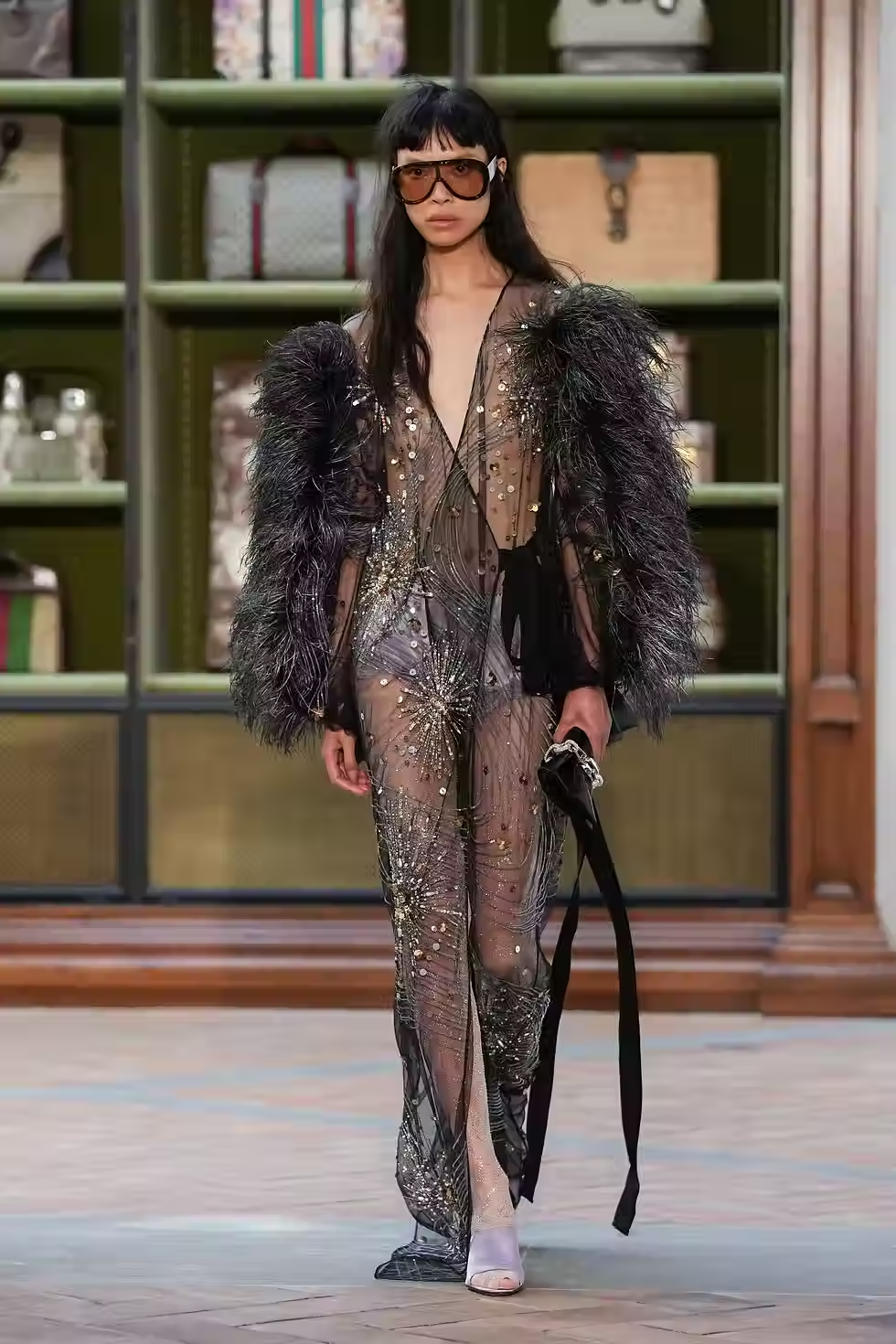
Gucci turned a store into a runway
In his second show at the helm of Gucci, Demna did something equally significant.
Instead of creating a world completely removed from reality, he turned a Gucci store into the setting for the collection.
The message was almost literal: fashion needs to reconnect with the place where its journey ultimately ends—with the consumer.
The show also marked an evolution from his first outing for the house. This time, there was less emphasis on provocation and more attention to Gucci’s heritage, versatility, and commercial appeal.
Luxury, it seems, no longer wants only to impress.
It wants to sell.
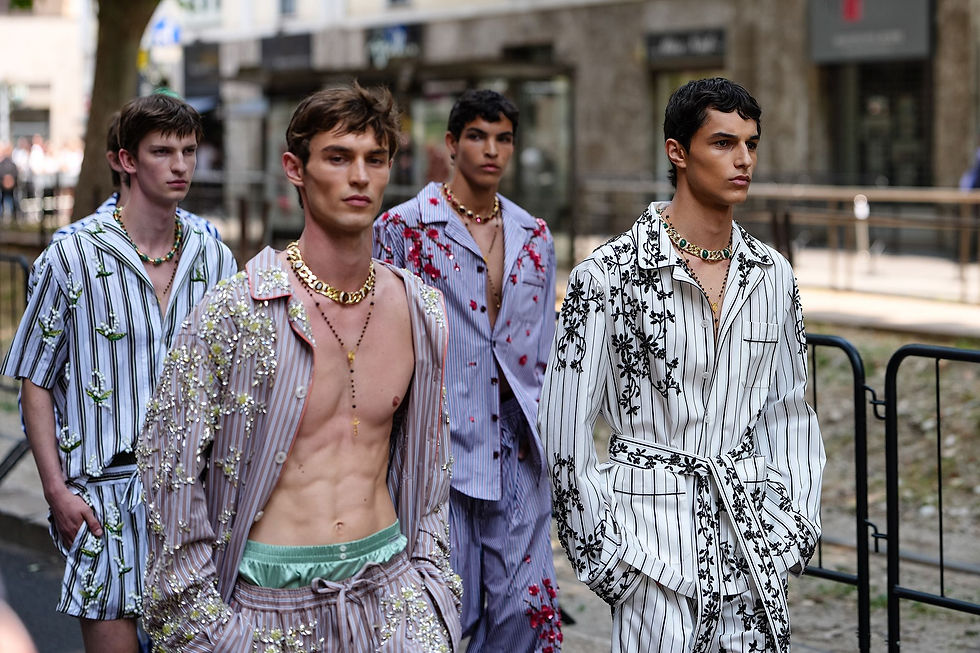
Moschino took to the streets
Moschino took a different path.
Loris Messina and Simone Rizzo made their debut as creative directors by placing their show in a far more everyday setting: models walked through a space shared with people dressed like anyone else in the city.
The choice helped break down one of fashion’s traditional barriers: the divide between those on the runway and those watching.
The collection also set out to update Moschino’s signature humor without relying solely on the visual stunts that made the house famous.
It was fashion within everyday life.
Not a fantasy completely removed from it.
And then the robots appeared
But if one image captured the tension between the present and the future, it was the appearance of humanoid robots during Vogue World: Milano.
Technology shared the stage with models and fashion figures in a show celebrating Italian craftsmanship and innovation.
The image was powerful.
It was also unsettling.
Because the question was no longer whether technology can be part of fashion.
That’s already happening.
The question is what role we want it to play.
The robots sparked mixed reactions precisely because they represent a boundary many industries are facing: the difference between using technology as a tool and allowing it to occupy spaces traditionally reserved for human beings.
And in an industry built around the body, identity, creativity, and personal expression, that discussion takes on another dimension.
Between tradition and the algorithm
Perhaps that’s why Milan felt so compelling this year.
On one hand, we saw craftsmanship, classic silhouettes, familiar garments, and references to the past.
On the other, we saw new creative directions, sets designed to become social media content, and robots walking down a runway.
Fashion is doing what it has always done: absorbing what’s happening around it and turning it into a language of its own.
But this time, the mirror reflects a different image.
An industry that needs to sell.
A consumer who wants to justify what they buy.
Brands that need to spark conversation without losing their identity.
And technology moving so fast that it’s no longer enough to ask what it can do.
We have to ask what we want it to do.
The real trend may be becoming human again
After taking in everything that happened in Milan, perhaps the most interesting conclusion isn’t about a skirt, a bag, a color, or a silhouette.
It’s about the need to reconnect.
With the consumer.
With clothing.
With identity.
With craftsmanship.
With the experience of wearing something because it represents who we are, not simply because it appeared in our feed for 15 seconds.
Fashion has always been an industry of transformation.
But in 2026, it seems to be transforming itself.
Milan didn’t tell us exactly what we’ll wear next summer.
It left us with a much more interesting question:
In an increasingly automated world, will fashion remain one of the ways we tell each other who we are?
Perhaps that’s the trend truly worth watching.


Comments